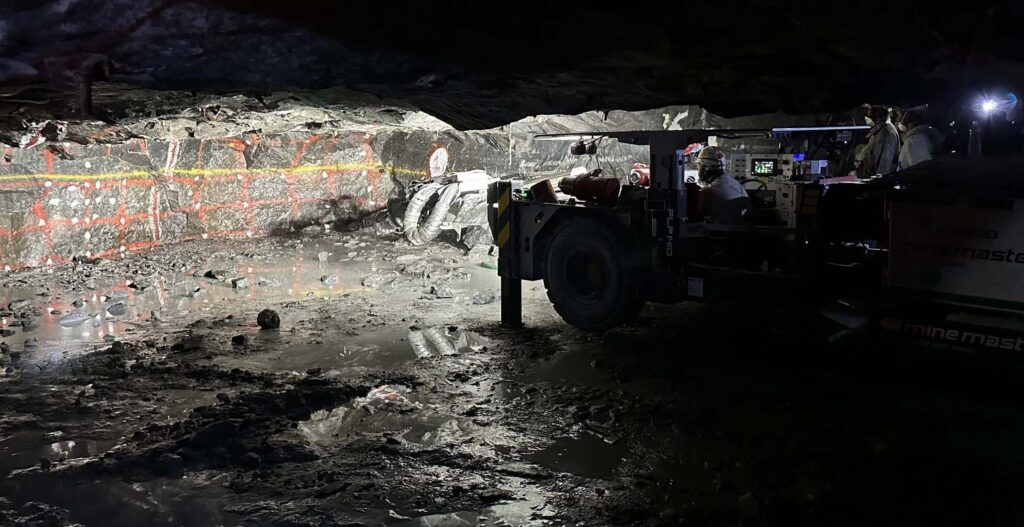
To choose an underground drilling rig, check the real conditions in the mine: the usable height of the heading, the gradient, the floor, the altitude, the water, the voltage and the work cycle. Together with the catalogue data and the figures from the enquiry, they decide whether a machine will work where it is supposed to. At Mine Master a specialist goes down the mine and checks them together with the client's technical team. Conditions in the mine are only part of the several dozen things we take into account when we design a machine for a given mine. Below we present several of the many aspects worth considering.
An enquiry usually starts with a conversation. Mine Master specialists often know the conditions in a region or a mine before the first call. An enquiry from some regions already suggests very low seams and machines around 1.40 m high, or narrow veins, and that points the project in a direction. Then come questions by phone or e-mail, and contact with our service teams working around the world, who know what to look out for in a given mine.
Before anyone goes down, there is already a body of information: from the client, about the geology, about the conditions in the mine, from cooperating companies, from resellers and from service companies. The visit adds one more element: the view from the place where the machine will work. The engineer who prepares the data often works above ground and goes down the mine from time to time, while the people who operate machines underground notice other things. Each of these views is valuable, and together they give the full picture.
During the visit we go through the information together with the client's technical people, both those who prepare the order and those who will operate the machine, and we compare it with what we see on site. Each mine is different, and this is how we come to understand the real working conditions and match the machine to them.
Even the best machine, if it is not properly matched, will not use its potential.
Witold HnatMember of the Management Board, Mine Master
This is only part of what we check together with the client. Below are seven of these checks, with the questions we ask on site.
| What we check | The question we ask together with you | What it decides |
|---|---|---|
| Height of the heading | What height is left under the conveyor, the pipes and the installations? | Whether the machine fits and what tramming height it needs |
| Gradient | How does the slope flatten out at the top? | Whether the machine can drive to the face without getting stuck |
| Floor | Is the floor muddy, are there holes, can the machine sink in? | Whether a heavy, low machine can reach the face |
| Access to the working place | How will the machine get to the exact place where it will work? | Whether it is assembled above ground or delivered in parts |
| Altitude | At what height above sea level does the mine lie? | Output of the combustion engine |
| Water | Where does the water come from and what temperature does it have? | Cooling of the machine, for example an additional cooler |
| Voltage | What voltage is there at the place where the machine will work? | Design voltage of the machine |
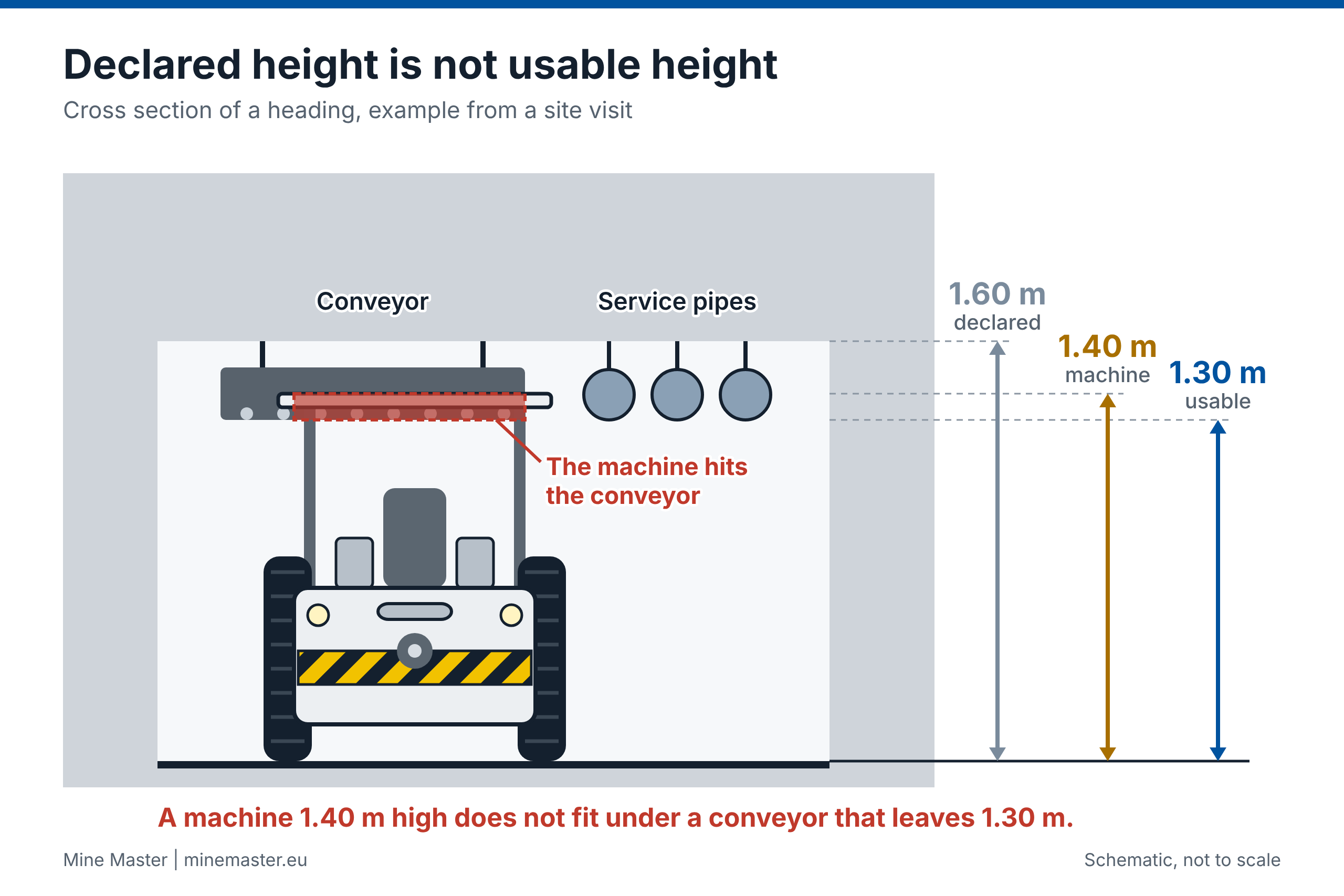
The height of a heading is usually given in the documents, for example as 1.60 m, and that figure is correct. Along the route there may also be a conveyor, service pipes and other equipment the mine needs, and together they can leave, for example, 1.30 m of usable height. For a machine 1.40 m high that difference matters. That is why, together with the client, we check the usable height at the place where the machine will drive, and not only the nominal height of the heading.
If a machine drives up a slope to a drift and the slope then flattens out, we check together with the client how this transition looks. The aim is that the machine does not get stuck on it. It is not a car, but a machine weighing over ten tonnes, and a machine that has got stuck is very hard to move.
We also look at the floor together: whether it is muddy, whether there are holes, whether the machine can sink in and whether it can reach the face. A low seam machine is compressed to the minimum and has little ground clearance. At 18 to 20 tonnes it can sink in wet, unpaved ground where miners walk or lighter machines drive without trouble. Our aim is that the machine reaches its place of work without surprises.
We look not only at the way into the mine, but at the way to the exact place where the machine will work. It decides whether Mine Master assembles the machine above ground or sends it ready, whether the client can commission it alone, whether it has to travel in parts, and whether it has to be assembled underground.
This is an aspect that is easy to overlook, and an example of knowledge we have gathered working in mines in different parts of the world. Altitude matters for combustion engines, which are built for given conditions. In one mine located over 1,500 m above sea level, engine efficiency dropped by more than ten percent, because the engine gets less air and oxygen and does not work in the conditions it was designed for. This is taken into account when the machine is selected for such a mine. In the extreme conditions of a mine, more than ten percent is a big difference. Many mines in Chile, Peru, South Africa and Zimbabwe lie high above sea level, so this parameter is especially important there.
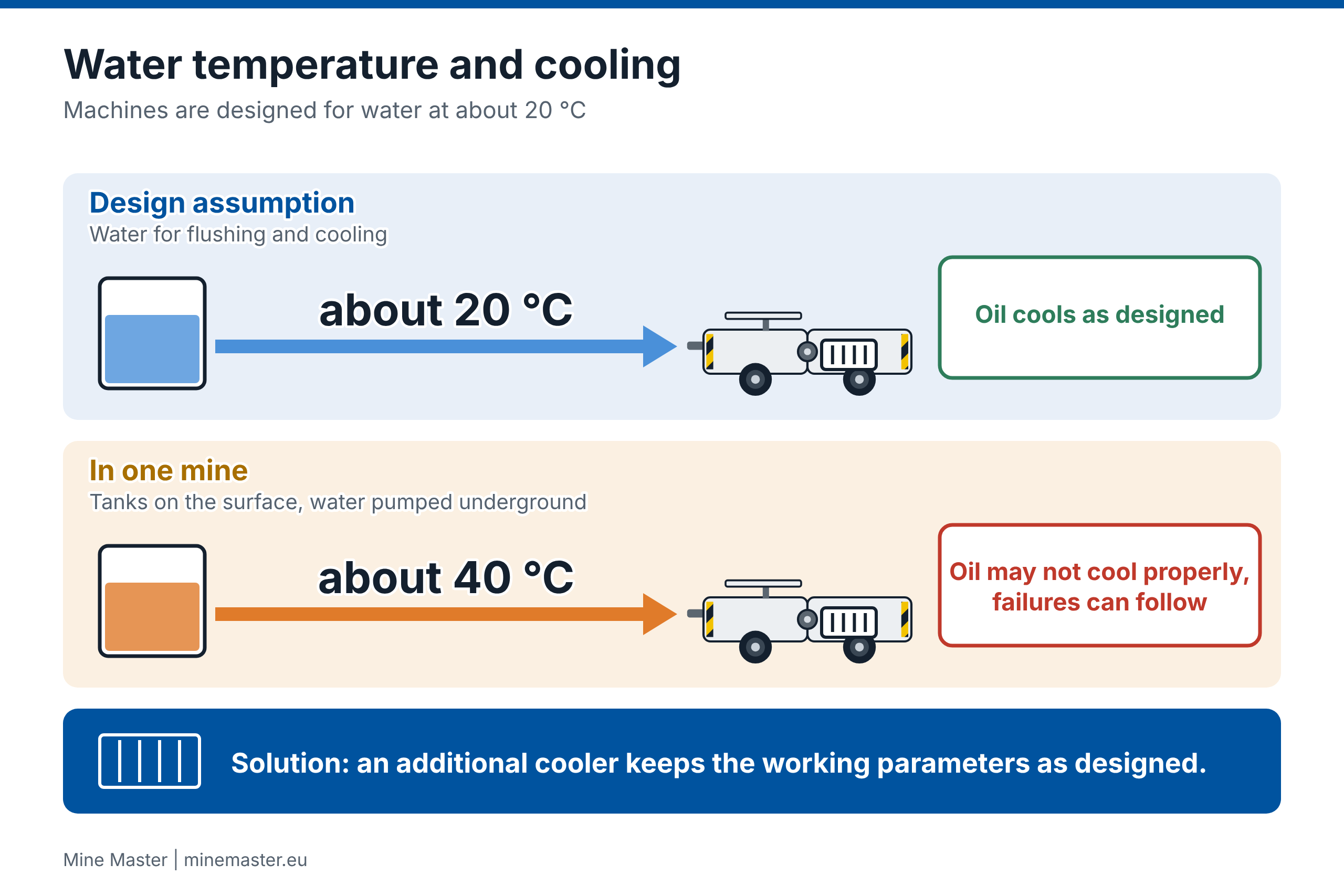
Water is another aspect that is easy to overlook. We check whether there is running water, where it is taken from and what its temperature is. Machines are designed assuming water at about 20 °C. The water is needed for flushing and cooling, and not only of the engine. In one mine the tanks stand on the surface and the water is then pumped underground. It turned out to have about 40 °C. Warm water like that can stop the oil from cooling properly and lead to failures. If only warm water is available, the machine can be given additional cooling, for example an extra cooler, so that the working parameters of the bolter, the drill rig or the production rig stay as designed.
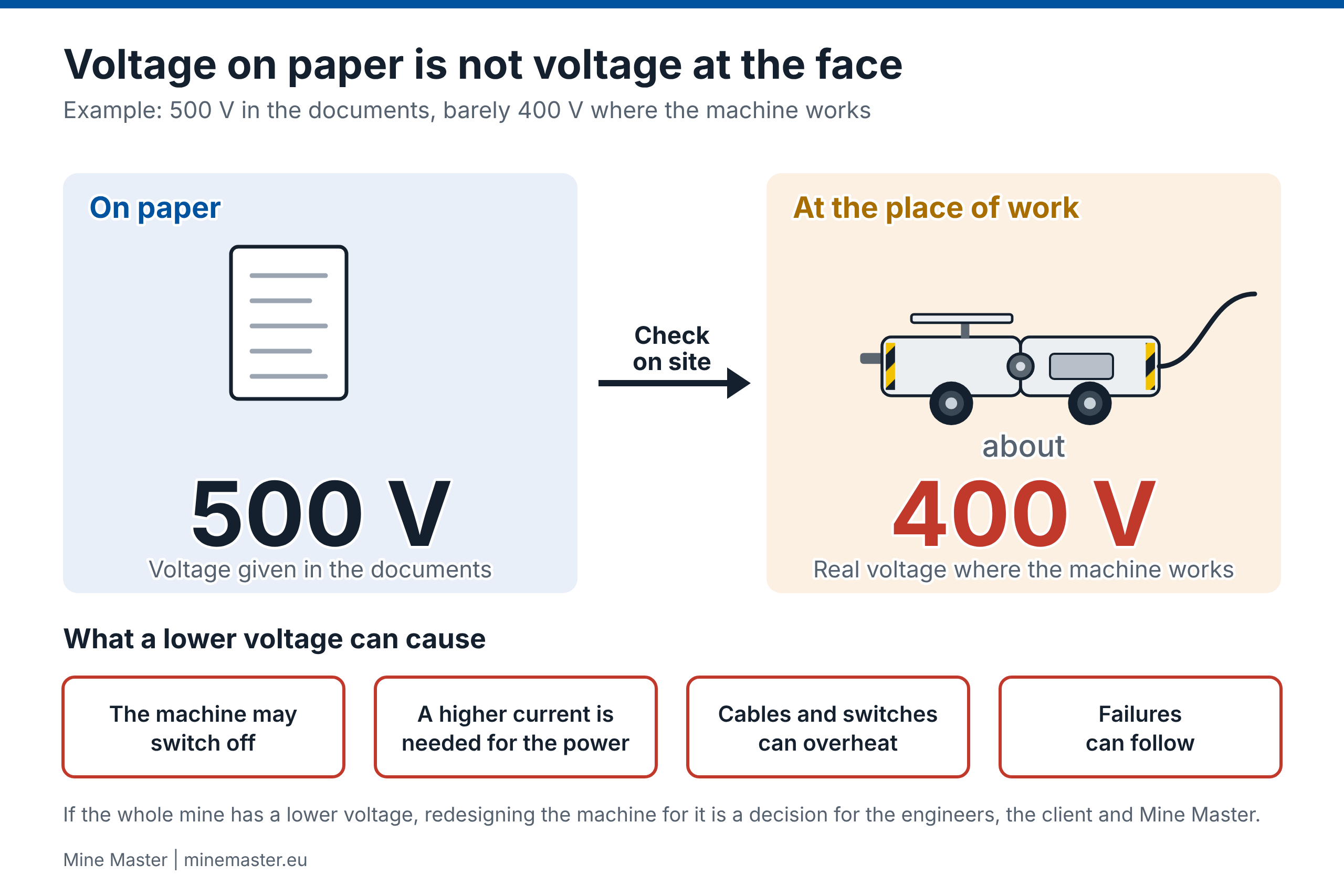
Voltage is an example taken from practice. We once met a mine where the documents gave 500 V, and at the place where the machine worked there was barely 400 V. Since then we check the voltage at the place of work, not only on paper, and we keep refining our checklist with every visit.
For a machine powered by cable, a lower voltage is a serious problem. At too low a voltage the machine may simply switch off. It also needs a higher current to reach the required power, which can overheat electrical parts, cables and the switches between the motors, and lead to failures.
First we check, together with the people on site, whether the problem is local or applies to the whole mine. If the whole mine has a lower voltage, we consider redesigning the machine for it. This is a decision for the engineers, the client and Mine Master.
This is not an obvious point to check, but it matters just as much. The machine has to fit the whole work cycle of the mine, from one blast to the next. Mines usually blast twice a day, for example around 6 in the morning and 6 in the evening. Face drilling rigs and longhole production rigs should work so that drilling speed, number of holes and capacity match the work of the whole mine.
A machine that can drill more holes helps nobody if the face is not ready for the next stage: not secured, not cleared of material, or not ready for the next blast. Then the machine simply stands idle. For the same reason there is no point in designing a machine with higher parameters than the mine needs. Parameters that are not pushed to the limit also mean fewer breakdowns. Two things matter most to the client: the fit to the work cycle of the mine and reliability.
Some things cannot be seen on paper. For roof bolters, one of them is the cross section of the heading. A trapezoidal drift is the simpler case: the bolter drives up, raises the mast vertically and bolts. In an arched, horseshoe shaped drift the situation changes. The mast bolts vertically, but when it starts tilting to the left and right to place the next bolts, it can meet the rock of the sidewalls, which protrudes in this profile. This has to be foreseen when a machine is designed for a given mine.
When a drift is narrower than it is high, the bolting mast may not be able to rotate normally. Then technical solutions such as horizontal shifts are needed, so that bolting is possible in that particular mine. The length of the bolts, their number and their spacing matter too, because a mine wants as few bolts and extra elements to install as possible. You can see our roof bolter range in the Bolting category.
The number of booms is also tied to the size of the heading. Narrow veins call for a single boom jumbo, while wide headings call for a twin boom machine. You can see both types in the Drill rigs category: single boom and twin boom jumbo rigs.
Gangue, also called veinstone or waste rock, is rock that contains no minerals, copper or ore, and the mine does not earn on it. Rock removed to make a drift wider has to be mined, crushed, brought up and hauled to the surface. A wider drift costs time, labour, energy, machines, machine wear and transport of material.
That is why drifts are made as narrow as possible, but wide enough for machines to pass, for walkways, ventilation and installations, and for safe work. The same logic applies to low seams. Bolters and drill rigs are necessary, but they do not produce the mineral the mine earns on, so they should not force the mine to enlarge a drift. For this reason we design compact machines with the smallest possible dimensions and a low cost of maintenance. If you work in such conditions, see our guide to narrow vein drill rigs and low profile machines.
After the visit the machine is configured for the mine, not for a model from a catalogue. This is what custom mining equipment means in practice: a machine tailored to the mine where it will work. Sometimes the standard configuration is enough, and the visit shows which case it is.
| What the visit shows | What changes in the machine |
|---|---|
| Water at about 40 °C instead of the designed 20 °C | An additional cooler, so that the working parameters stay as designed |
| Lower voltage in the whole mine | The machine is redesigned for the voltage that is really available at the face |
| Electrical installation already run under the roof | No cable reel, so the machine is shorter, cheaper and more manoeuvrable |
| A drift narrower than it is high | A horizontal shift of the bolting mast |
| Holes and an uneven floor | An oscillating joint between the front and the rear of the machine |
The client gives us a task and we propose a solution. This is closer to selling a solution than to selling a machine, and that is why going down the mine is obligatory: checking the conditions, going through the checklist and matching the machine. The machine is only one of the client's many tasks. The client also deals with ventilation, water, voltage, people and the installations of the whole mine, and does not necessarily want to select the machine in detail. That is where our work starts.
Every sales specialist at Mine Master is a very technical person. He goes underground, examines the conditions, talks to people, takes part in preparing the machine, passes on his notes and gives recommendations. For more advanced machines he consults the technical department, but he is a practitioner with years of experience. He is not a miner, which is why he talks to the miners and operators who will work with the machine every day.
A good match has two tests. For the person who decides, the machine has to be worth its price: not the cheapest and not the most expensive. For the operator, it has to work well underground every day, in the conditions of that particular mine. The solution has to pass both tests, and the only way to know is to ask both groups on site. That is why we do not stop at the specification: we go underground, talk to the decision makers and the people who will work with the machine, and test the machine for the given conditions, working environment and application.
If you are still comparing types of machines, start with our guide to underground drill rigs.
Start with a conversation with the supplier and a visit to the mine. The specialist checks whether the data given earlier matches the real conditions underground and talks to the people who will operate the machine. Only then is the machine matched to that mine.
The conditions the machine will work in matter as much as the catalogue: the usable height of the heading, the gradient and floor on the way to the face, altitude, water temperature, the voltage at the place of work and the work cycle of the mine.
The declared height describes the heading itself, while the conveyor, service pipes and other equipment that run through the mine reduce the space left for the machine. A heading declared as 1.60 m can leave only 1.30 m of usable height, which is less than a machine 1.40 m high needs.
No. Sometimes the standard configuration is enough. The visit to the mine shows whether something has to be added, removed or redesigned for the conditions.
The customer defines the task and Mine Master proposes a solution, not only a machine. The specialist checks the conditions underground, and the solution has to make business sense for the decision makers and operational sense for the people who work with the machine every day.
Planning a machine for your mine? Every conversation with our specialists starts with the basic data: the height and shape of the heading, the gradient, the altitude, the water temperature and the voltage at the place of work. Send it by phone or email through the contact page, and we will tell you what else needs to be checked before the visit.
Mine Master Spółka z o.o.
Wilków, 59-500 Złotoryja
ul. Dworcowa 27
tel: +48 (76) 87 83 511
info@minemaster.eu
NIP: 6940007277
PKD: 2892Z
REGON: 390234796
KRS: 0000114912

