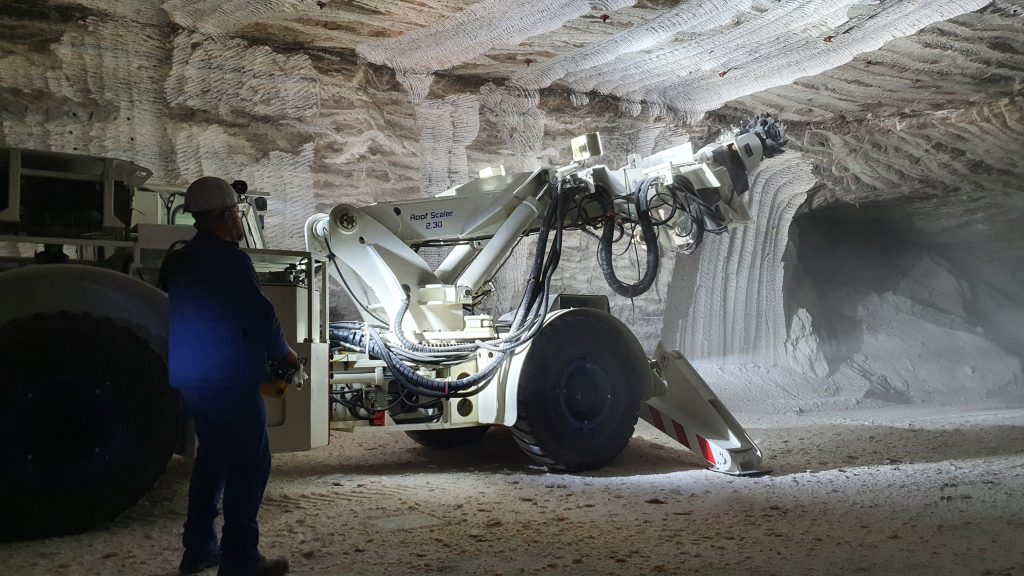
After drilling and blasting, the roof, walls and face of an underground excavation are not immediately stable. Cracked layers, loose fragments and unstable rock blocks may remain in the roof and walls, partially attached to the surrounding rock mass. This creates a risk of uncontrolled detachment and falling material that can injure personnel or damage equipment. Scaling is the mechanical removal of this material before any further work begins in the area. Machines built for this purpose, underground mining scalers, are standard equipment in underground mines that carry out drilling and blasting.
Scaling is the removal of loose, cracked or unstable rock from the roof, walls and face of an excavation, usually carried out right after drilling and blasting. Roof bolting is a different process: it reinforces the rock mass by installing bolts that tie weaker layers to more stable strata. Scaling physically removes the hazard, bolting stabilizes what remains.
In a typical work cycle, scaling is carried out before bolting - hazards are removed first, then the remaining rock mass is stabilized. This sequence can vary depending on a mine's work organization and procedures.
Scaling can be done manually with a scaling bar, but in larger mining operations, dedicated scaling machines are standard. They keep the operator at a safe distance from unsupported rock and reduce the time needed to prepare an excavation for further work.
Loose rock detaching and falling is one of the fundamental hazards in underground mining, alongside gas, fire and machine-movement hazards. The risk increases with mining depth: stresses in the rock mass grow, rock structure changes, and the roof and walls are subjected to greater loads.
Systematic scaling:
The extent of scaling required also depends on the quality of earlier work. Precise drilling and controlled blasting produce a better roof, wall and floor geometry, reducing the number of irregularities and loose rock fragments that must be removed afterward. Scaling is therefore not a process detached from the rest of the mining cycle - its scope depends, among other things, on the accuracy of the preceding drilling and blasting.
A mining scaler is a self-propelled machine fitted with a hydraulic breaker, a pick, or a rotary cutter head mounted on a boom. The operator guides the tool along cracked or loose sections of rock, breaking the material free so it falls safely to the floor, where it is cleared separately.
Typical sequence of work:
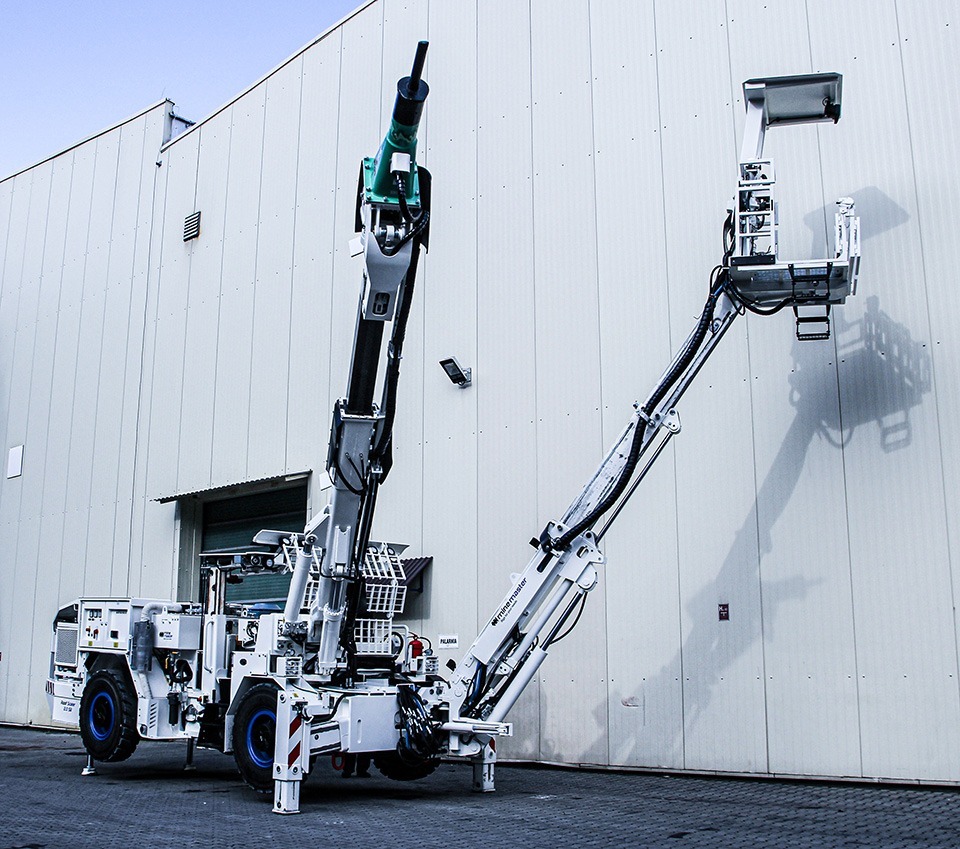
Some scalers have two booms: one working boom (breaker, cutter head) and a second with an inspection basket, allowing the scaling function to be separated from inspection. Remote control is also standard equipment - the operator can control the breaker or cutter head from outside the cabin, using a wireless control panel, while remaining behind a laser barrier that marks out the working zone.
A mining scaler combines a self-propelled chassis with a hydraulically operated boom and interchangeable working attachments. Typical design elements include:
The primary criterion for selecting a scaler is the working tool - chosen according to rock hardness and sensitivity to vibration. A second important criterion is the machine's configuration (number of booms) and reach, matched to the height and width of the excavation.
| Criterion | Scaler type | Typical application | Mine Master example |
|---|---|---|---|
| Working tool | Hydraulic breaker | Removing loose fragments of hard rock after drilling and blasting | Roof Scaler 2.0SB |
| Working tool | Cutter head / pick | Controlled scaling of soft rock and vibration-sensitive formations (salt, potash) | Roof Scaler 2.3D |
| Configuration | Twin-boom | Separate working boom and boom with inspection basket | Roof Scaler 2.0SB |
| Reach | Low profile | Lower, more confined excavations | Roof Scaler 2.0SB (min. tramming height 2.0 m) |
| Reach | Extended reach | Higher, wider excavations; scaling of roof, walls and floor | Roof Scaler 2.3D (reach up to 9.0 m) |
| Control | Cabin or remote | Working within a zone protected by a laser barrier | Both Mine Master machines |
Mine Master manufactures underground mining scalers for the mechanized removal of loose and cracked rock. Below are details of two models, each dedicated to different rock conditions.
A twin-boom machine with a Montabert SC22 hydraulic breaker on the working boom and an inspection basket (meeting FOPS requirements, for two people) on the second boom. Designed for hard rock and low-profile excavations - minimum tramming height is 2.0 m. The breaker can be operated from the cabin or remotely, from a wireless panel, with the operator remaining behind a laser barrier. Diesel power or connection to an electric network.
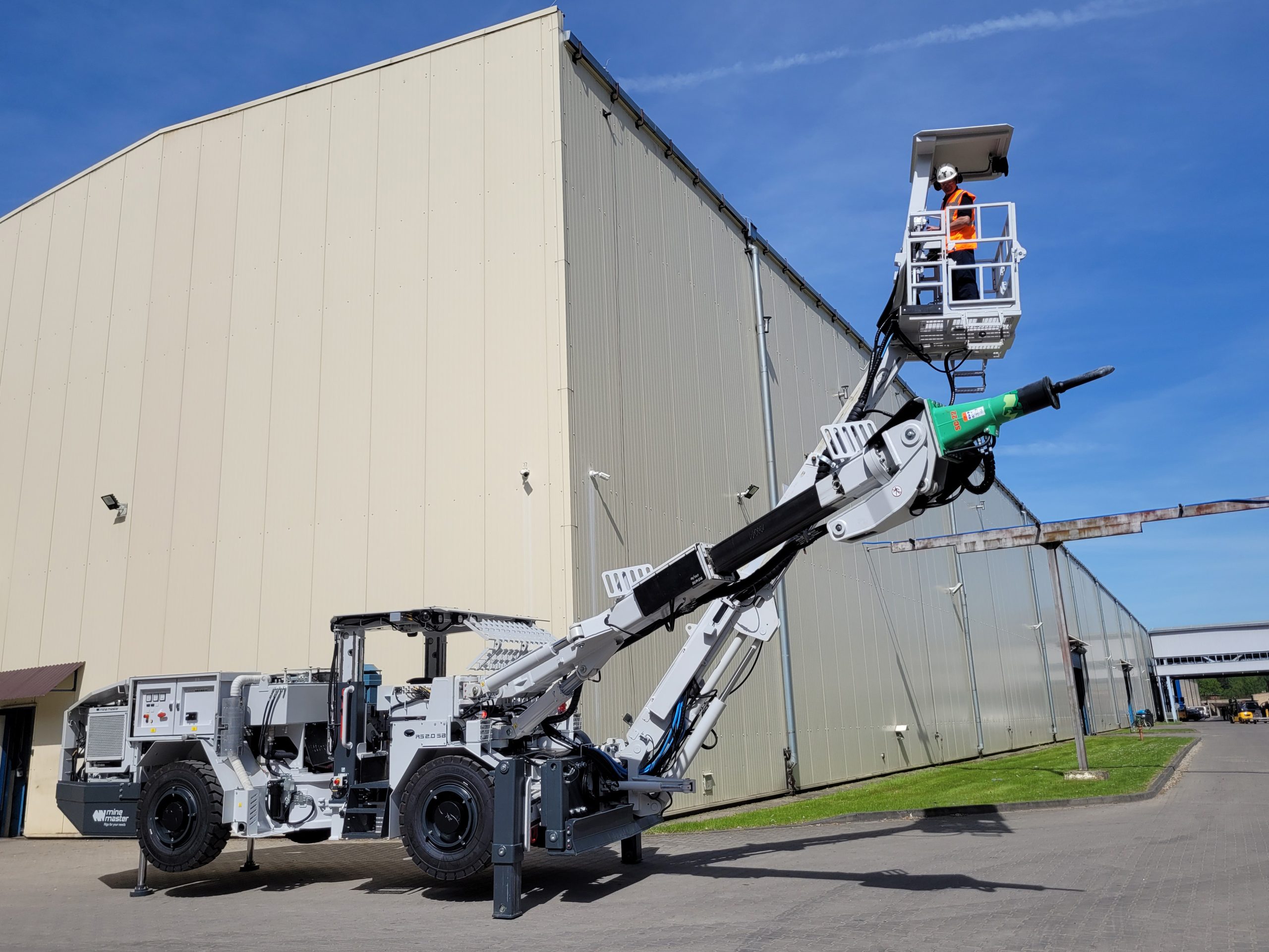
| Parameter | Roof Scaler 2.0SB |
|---|---|
| Length | 11.6 m |
| Width | 2.25 m |
| Height | 2.7 m |
| Weight | 21.9 T |
| Working reach | 6.2 m |
| Min. tramming height | 2.0 m |
| Min. width of heading for tramming @90° | 3.6 m |
| Working tool | Hydraulic breaker Montabert SC22 |
| Power source | Diesel / Electric |
Depending on mine conditions, both tramming and boom operation can be performed using the diesel engine or an electric network - the choice of power source is not fixed to tramming or working specifically, it depends on the infrastructure available in a given excavation.
A machine for soft rock, including rock salt and potash, where using a hydraulic breaker would be undesirable due to vibrations affecting the rock structure. Fitted with a rotary cutter head or a pick, selected as needed. Coverage of up to 9.0 m in height, with the ability to work 0.5 m below floor level - allowing scaling of the roof, walls and floor of the excavation. Remote control from outside the cabin via an external panel.
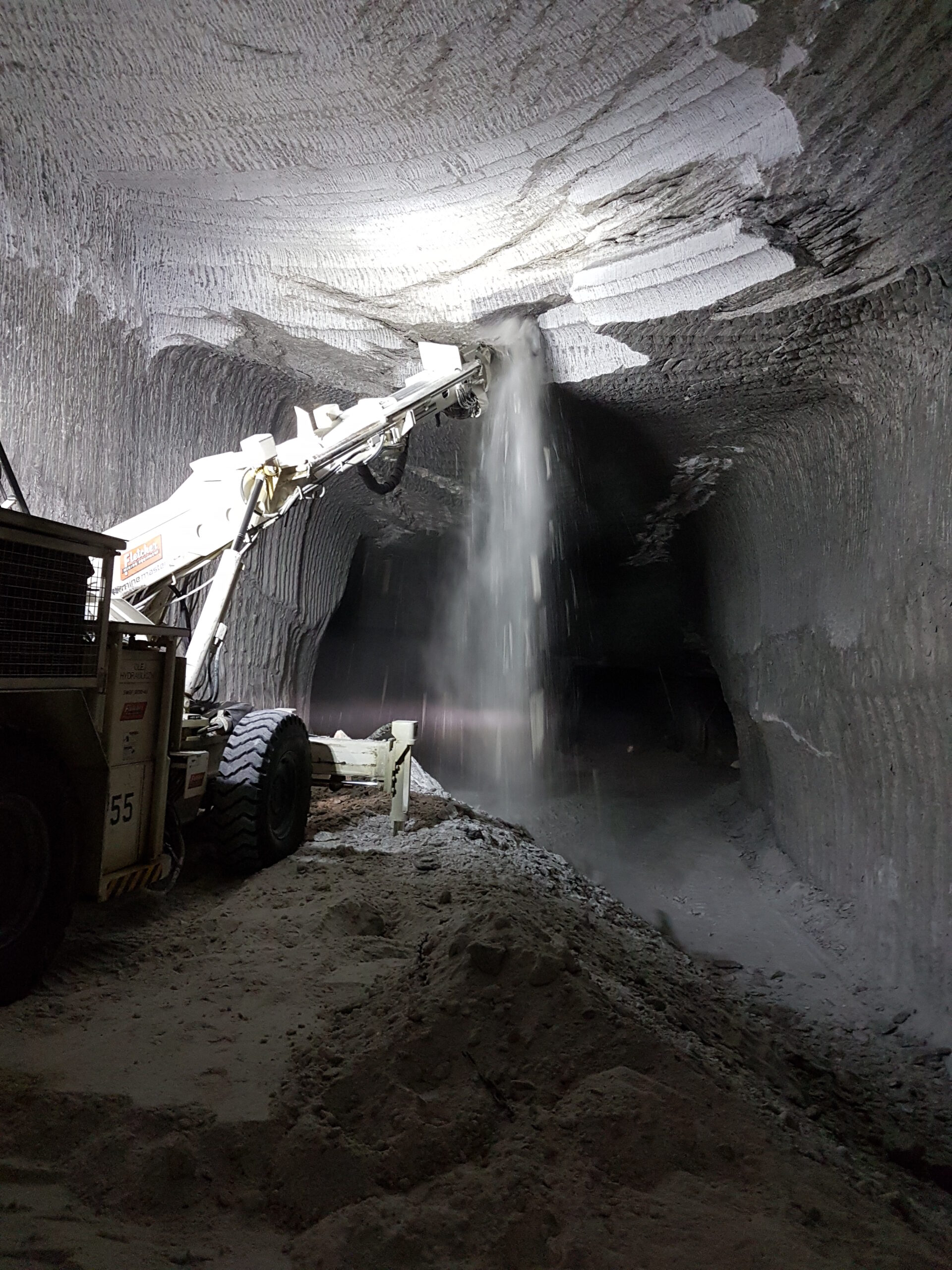
| Parameter | Roof Scaler 2.3D |
|---|---|
| Length | 11.5 m |
| Width | 2.65 m |
| Height | 2.3 m |
| Weight | 26.0 T |
| Working reach | Reach: 8.5-9.0 m |
| Min. tramming height | 2.3 m |
| Min. width of heading for tramming @90° | 4.7 m |
| Working tool | Rotary cutter head or pick |
| Power source | Diesel / Electric |
| Scaling range | Roof, walls, floor |
| Region / client | Rock type | Challenge | Mine Master solution |
|---|---|---|---|
| Zimbabwe – underground hard rock mine | Hard rock | Safe roof inspection and mechanized removal of loose rock in low-profile excavations | Roof Scaler 2.0SB (several machines developed based on the client's operating experience) |
| KGHM (Poland) - rock salt deposits | Soft, vibration-sensitive rock | Limiting vibration during scaling within the salt deposit structure | Roof Scaler 2.3D – 3230-AD variant, developed jointly with J.H. Fletcher - cutter-head scaling of the roof, walls and floor |
Scalers work directly beneath unsupported rock, which is why safety features are an integral part of the design, not an add-on:
The latest Roof Scaler 2.0SB units, delivered in 2026 to a customer in Zimbabwe, are additionally fitted with a lidar system that monitors the danger zone around the working tool. If the system detects a person entering that zone while the machine is operating, it automatically locks out the working functions. This change comes from the client's years of operating experience and illustrates how feedback from the mine shapes later versions of the design.
When selecting a scaler for a specific excavation, the key factors are:
Machine configuration (boom reach, working tool, tramming height, power source, safety package) can be adapted to the geology and organizational requirements of a specific mine. Mine Master delivers both standard models and projects developed jointly with clients and technology partners, such as J.H. Fletcher.
The mechanical removal of loose, cracked or unstable rock from the roof, walls and face of an excavation, usually carried out right after drilling and blasting.
A scaler removes loose material. A roof bolter reinforces the rock mass by installing bolts. In a typical work cycle, scaling precedes bolting.
A hydraulic breaker for hard rock; a pick or rotary cutter head for soft, vibration-sensitive rock (salt, potash).
Yes. Mine Master scalers offer remote control of the working tool from a wireless panel, with the operator positioned in a zone marked out by a laser barrier.
No. Machine selection depends on rock hardness, excavation height and width, required reach, and the safety systems used at a given mine.
Yes, as part of projects developed jointly with the client and technology partners, as with the Roof Scaler 2.3D / 3230-AD developed with J.H. Fletcher.
Mine Master Spółka z o.o.
Wilków, 59-500 Złotoryja
ul. Dworcowa 27
tel: +48 (76) 87 83 511
info@minemaster.eu
NIP: 6940007277
PKD: 2892Z
REGON: 390234796
KRS: 0000114912

